4 Reasons Emotionally Unavailable Partners are Attractive
You want love...so why do you keep choosing partners incapable?
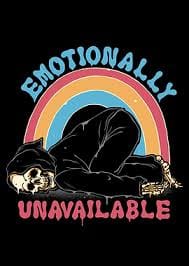
An emotionally unavailable partner is someone who isn’t self aware who represses their past traumas and current emotions rather than processing them and growing from them.
Unfortunately, emotionally unavailable partners also shut off their own empathy and self love — to deal with the painful emotions they don’t process, they project them through abuse, ghosting, and frequent betrayals and abandonment.

They make other people feel the way they feel about themselves.
This means you can find yourself in love with, even addicted to, someone who cheats on you, emotionally or physically abuses you, ghosts you, belittles your accomplishments, neglects you, and betrays you.
All my life, I wanted the thing that I never got in my childhood: unconditional love.
To get it, I felt that I needed to give it: I treated others the way I wanted to be treated. I kept getting blindsided by betrayals and stunning discoveries of shames that my partners had.
After two long-term relationships ended in rubbles, I decided in my 20s that I was no longer going to pursue dating: I’d simply sleep with men and give them the freedom they desired. Sex was the lowest rung on the ladder I could reach, because I was worthless and undesirable.
Still, I wanted to sleep with QUALITY men, and I thought that was what I was choosing.
I chose professors, artists, hardworking blue-collar men…I chose people who, at first, seemed kind, even if they seemed traumatized like I did.
But I kept finding myself in the same patterns with men who treated me like dirt, and when I’d ask them to communicate their feelings, I’d get a sigh and “I don’t know.”
At best, they might tell me they felt “bad” or felt “disgust,” but they couldn’t articulate beyond that or connect their emotions to their behaviors.
They were a mystery.
In therapy, I kept trying to figure out what was wrong with ME that I would continually attract covert narcissists and sociopaths as a MAGNET.
Here’s what a pattern of emotionally unavailable partners says about you and what you need to heal:
1. You think you’re unlovable
Emotionally unavailable partners feel safe when your core belief is that you’re unlovable.
If a person is not in touch with their emotions, then they can never love you.
If they can never love you, then they can never reject you.
If they can never reject you, then it’s as if they were never there.
If they were never there, then there’s no love for you to lose.
If there’s no love for you to lose, then you won’t be reminded that you’re unlovable.
If you aren’t reminded that you’re unlovable, you won’t be triggered to remember your childhood in which you felt unloved.
If you aren’t triggered to remember your childhood, then there’s nothing to grieve.
The emotionally unavailable partner is the drug that numbs the grief of your childhood that you want to avoid.
2. You’re a healer in training
If you’re an empath, you will, without question, find yourself entangled with sociopaths in your life.
The empath and the sociopath cannot resist each other.
The empath is attracted to the deepest wounds, because the empath is guided by their purpose as a healer.
However, the empath spends much of their life unaware that some wounds are fatal, so they spend countless years examining the wounds of the WALKING DEAD.
This work isn’t for nothing, and — despite the canterkerous and ruthless behaviors of sociopaths towards empaths — sociopaths know the power of an empath, and they do learn lessons from us, painful ones.
Sociopaths are also attracted to an empath for their wounds, but they have the hopes to exploit the wounds to dominate the empath, not to nurse them to heal them.
The empath, if they survive, will learn that some wounds are beyond their power to heal, but their experiences with those who cause the gnariliest wounds will make them even more powerful healers throughout their lives.
Their experiences in the darkness will magnify their light as they learn they must heal themselves.

3. You think your emotions are a weakness
People who are attracted to emotionally unavailable people often fear the intensity of their own emotions.
They have often been told that emotions are a flaw: they make them a burden or weak. They’ve been instructed that those without emotion have a stronger grasp on logic.
Therefore, they seek partners who exhibit only ANGER as their most dominant emotion. They perceive that those in touch with anger are strong and will protect them from predators.
When in reality, those people ARE the predators.
They continually repress their own emotional needs for their partner, catering to their anger, even as it turns its jaws upon them.
Without having a strong grasp on empathy, a person is totally devoid of logic, and that person can easily slip into delusion, denial, and grandiosity.
Strong logic needs both the head and the heart.
4. You had an emotionally unavailable parent
Both of my parents have Narcissistic Personality Disorder and Antisocial Personality Disorder. My sister was golden to mom, scapegoat to dad. I was scapegoat to mom, invisible to dad. My sister got NPD and I got BPD.
My whole life, I was surrounded by emotionally unavailable people who treated me poorly but whose love I wanted deeply and who I had a well of endless compassion for. Yet, I couldn’t understand why my own family seemed to deny my own humanity, when I walked on eggshells for theirs.
I unmasked my mother early: by the time I went to college and studied psychology, I knew my mother’s disorder.
Discovering my own took much longer, a couple more decades, and working through the shame of my BPD was also extraordinarily difficult, as I was raised in the cult-like environment of a narcissistic household that shamed trauma responses and mental health, constantly reinforcing that I wasn’t lovable unless I was perfect.
And my father’s was the last person I loved who I unmasked as a covert narcissist.
When I did, I was shocked by how OBVIOUS it was, how much I’d willfully DENIED.
The truth was, I couldn’t bear the thought that I survived my childhood totally unloved. I wasn’t strong enough to grieve that horror yet.
I was clinging onto the idea of my father as a victim to my mother — who just happened to be heavily co-dependent and emotionally neglectful and passively abusive. Since childhood, I’d idolized my father.
I needed him to be that idealized version so that I could feel safe, even though he not only didn’t protect me: he was willfully passive to physical abuses happening to me at the hands of my mother and he was emotionally neglectful. He even did covert abuses to hurt me intentionally that I internalized and excused to protect the idealized version of him in my mind.
Because the alternative — the truth — meant my father never loved me.
No one in my family did.
And I couldn’t survive that. I needed the delusion of love to survive.
But what happens when you deny something and sidestep grief is that you bury it in your body.
And your body keeps trying to resolve it — either by getting sick and breaking down to annihilate the threat of it, or by addiction to mask it, or by trauma bonding to relive it.
Over and over, I found myself with men who looked nothing like my father, who didn’t have the same hobbies as my father, who had very different mannerisms and opinions than my father…but….when it came to abuse, emotional neglect, repression of trauma, and their narcissism…THEY WERE THE AVATAR OF MY FATHER.
Even my stalker mirrored my father so much that it seemed supernaturally uncanny.
If you don’t break denial and go through the process of grieving to heal your past pain, you’re cursed to keep reliving that pain.
Like a ghost, you keep visiting the scene of your death.
You hope this time there will be a different ending.
You pray to return to the land of the living when your heart was stolen from you.
But the same horror replays once again: the same monster returns in a new mask.
Beneath the mask, the monster has no emotions and cares nothing for what happens to the victim.
Again.
The monster doesn’t even have a REAL SELF.
They’re just a mask, a void, a black hole you desperately try not to get sucked into.
But….did you forget?
You’re made of stars.
No one’s going to swallow your light that easily.
You think the false idol holds a chance against the power of the true divine?
Even before you burn out, you’re destined to go SUPERNOVA first.
So, do what you came here to do: SHINE YOUR LIGHT.

For individual coaching or group healing sessions, visit https://am-champion.com
 Follow
Anne M. Champion is the author of She Saints & Holy Profanities (Quarterly West, 2019), The Good Girl is Always a Ghost (Black Lawrence Press, 2018), Book of Levitations (Trembling Pillow Press, 2019), Reluctant Mistress (Gold Wake Press, 2013), and The Dark Length Home (Noctuary Press, 2017). Her work appears in Verse Daily, diode, Tupelo Quarterly, Prairie Schooner, Crab Orchard Review, Salamander, New South, Redivider, PANK Magazine, and elsewhere. She was a 2009 Academy of American Poets Prize recipient, a 2016 Best of the Net winner, and a Barbara Deming Memorial Grant recipient.