
4 Things Being Ghosted Says About You
#4 May Surprise You...

I’m the queen of being ghosted.
It first happened in 4th grade when I fell in love with Jack.
One day, he was passing me a note asking me to go out with him; the next day, he didn’t even choose me for his team in soccer at recess. Hours later, he finally had a friend call to let me know I was dumped.
The pain of being ghosted is deeply rooted in my body. The child of two parents with ASPD, I felt that even my parents ghosted me.
Adolescence saw me entangled with bad boy after bad boy — a revolving carousel of different flavors of sin.

Compatibility was no factor: what we had in common was TRAUMA.
Aside from two long-term relationships in early adulthood, I’ve been single. My early relationships were riddled with cheating and abuse: coupled with my childhood trauma, I developed a disorganized attachment style.
I deeply wanted intimacy, but I feared burdening people with my emotional needs and driving them away. Simultaneously, I also feared those who wanted to engulf, abuse, and control me.
What that translated to was a girl with a raging sex addiction whose drug of choice was abusive men.
But I didn’t know I was doing that.
Oh no — I thought I was looking EVERYWHERE for love.
I dated and casually slept with men from all walks of life, all social classes, all types of careers, all races and cultures.
But I encountered a common trend: I kept getting ghosted.
Mysteriously.
It happened after having wonderful, passionate, and even intimate, times with men.
I’d get ghosted right when I felt sure love had finally come to make its nest above my door.
In the HBO TV series, Sex & the City, Carrie is shaken to be broken up with via Post-it note: “I’m sorry. I can’t. Don’t hate me.”
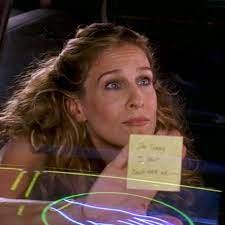
Before being broken up with, this boyfriend delivered what the women felt was the most life-changing revelation.
During their usual pow-wows to disect their love lives, Miranda shares a lukewarm dating story from a man she’s waiting to hear from again. Carrie’s boyfriend replies, “I’m sorry to say, but he’s just not that into you.”
The women take a moment gasping at their wounded egos, assuring each other that there are many other circumstances to excuse someone’s lackluster enthusiasm post-date.
But eventually, they settle on this being the most liberating advice they’ve ever had:
He’s just not that into you. Move on!
At the time I watched, this seemed like sage advice.
But the actual experience of being ghosted was more like those Gravitron rides at a carnival: you walked into this flashy spaceship thinking it was just a hop-on, hop-off good time, and then you find yourself glued to a padded wall by mysterious forces as you upchuck some fried dough and powdered sugar.

One problem was that the men who ghosted me typically reappeared again, which muddied the “not that into you” message.
And in other ways, they could seem downright obsessed with me — such as how they texted, how jealous they got, how much passionate sex we had, or how fervently they wouldn’t let me leave them.
The other problem was how hard I was trying to be good enough not only not to be ghosted, but to be loved and needed.
What exactly was I missing that I kept finding myself alone with a bottle of wine in lingerie staring at an “OMW” text from five hours ago?
FOUR THINGS BEING REPEATEDLY GHOSTED SAYS ABOUT YOU:
1) You’re trauma bonding

Being repeatedly ghosted is often a way that our childhood wounds are re-created.
Those who practice ghosting are expressing their own childhood traumas and unhealed toxic cycles as well.
A trauma bond is when you develop an unhealthy emotional attachment to someone who causes you harm.
Anyone can form trauma bonds, and these attachments can even be towards things like work, but people are exceptionally prone to trauma bonding when they have parental trauma: when the same person who caused you harm was who you needed to survive.
Abuse and neglect are relieved by intermittent periods of reinforcement via breadcrumbs of affection or lovebombs which creates a chemical dependency to dopamine in the brain that’s just as difficult to break as a drug addiction.
When you trauma bond, you date people who have unhealthy attachment styles — very often, you’re unconsciously driven to people who may have had the same mental health disorders as your parents.
For me, that meant I slept with quite a few sociopaths.
Instead of, “He’s just not that into you,” it might be worth considering the option, “He’s just Ted Bundy.”
2) You’re intimidating
Once, I became so enamored with a man that his ghosting erased my entire ability to see myself.

He was beautiful, intelligent, fit, well dressed, British, well traveled, an Oxford graduate, an Ivy League professor.
I did more than put him on a pedastal — more like I carved his face into a canyon in my brain like Mount Rushmore.
Because I thought he was so perfect in my idealization, I’d be doing everything to peacock my feathers of lovability around him.
I’d want to show him the poems I’d gotten published or the books I was reading. I’d read books about his interests just to have informed conversations with him. I’d clean my house and devote myself to beauty rituals obsessively. I bent to his every sexual fetish.
He’d coo, “Where have you been all my life?” and “I’ve missed you.”
Then he’d vanish again for months.
When he did, it left me able to only see myself in the most warped way: I thought, of course he should be ashamed of me. I’m too fat, I’m not wealthy and wasn’t born into wealth, I’m not smart enough…
The last I spoke to him was during the 2020 lockdown. I was several years celibate and working through a lot of my trauma, and he sent me a hoover text asking to hook up. I recognized by then that he was a narcissist.
I let him know that I moved states, and I also let him know that I’d healed too much for the games we’d played years ago.
Then he said the real reason he’d always ghosted me: “You always were so intelligent that it was intimidating.”
“Really?” I replied, “I genuinely thought you thought I wasn’t smart enough for you.”
He said, “Every time I left you, I thought, ‘She’s the whole package. She’s going to find someone new soon.’”
“If I was so great, why didn’t you put any effort into us being together in a real way?”
“Because I was sure that soon you’d discover how great you were, and when you did, you’d realize you were too good for me.”
The truth of what the ghosting meant was nearly the opposite of what I’d processed it to mean all those years.
3) You have low self worth
The ways those we share intimacy with treat us reflect our unconscious feelings and insecurities about ourselves.

If you’re intimate with someone who lies to you, then, on some level, you lie to yourself.
If you’re intimate with someone who cheats on you, then, on some level, you don’t think you can fulfill someone sexually.
If you’re intimate with someone who abuses you, then, on some level, you think you deserve abuse.
If you’re intimate with someone who ghosts you, then, on some level, you’ve abandoned yourself.
4) You’re very lovable
Often, the reason someone ghosts isn’t because you’re not enough, but because you’re more than enough.
People who ghost are not emotionally mature, because an emotionally mature person would be able to communicate and empathize with the person they are ghosting.
People who are not emotionally mature are incredibly insecure, even though they may appear to be the opposite: they are self absorbed and constantly comparing themselves to others.

It’s likely that in comparing themselves to you, they kept bumping up against sharp edges that made them feel insecure: your light illuminated the shadows inside them where they brush the dirt under the rug, revealing a mound of mold, moths, and mortifications.
When a creature of darkness meets light, it cowers, scampers, and hides.
Don’t let ghosting rob you of your self worth: it may just be a sign that you have TREMENDOUS lovability.
So, if you find yourself repeatedly ghosted, it may be time for you to try a new dating experience: spend some time romancing someone you’ve never in your wildest dreams thought of wooing before…
Fall in love with yourself.

My memoir, This is a Story About Ghosts: A Memoir of Borderline Personality Disorder, is now available on Amazon.


For individual coaching, visit https://am-champion.com
If you’d like to support my writing, hit the clap, check out my books, or Buy Me a Coffee.
Follow Blooming on the Borderline on Facebook.
A.M. Champion is the author of She Saints & Holy Profanities (Quarterly West, 2019), The Good Girl is Always a Ghost (Black Lawrence Press, 2018), Book of Levitations (Trembling Pillow Press, 2019), Reluctant Mistress (Gold Wake Press, 2013), and The Dark Length Home (Noctuary Press, 2017). Her work appears in Verse Daily, diode, Tupelo Quarterly, Prairie Schooner, Crab Orchard Review, Salamander, New South, Redivider, PANK Magazine, and elsewhere. She was a 2009 Academy of American Poets Prize recipient, a 2016 Best of the Net winner, and a Barbara Deming Memorial Grant recipient. She has degrees in Behavioral Psychology and Creative Writing.